

Our Manchester solicitors can represent employers and employees in a wide range of legal matters deriving from the employment legislation.
| Quick Facts | |
|---|---|
| Court assistance in employment matters offered by our employment solicitors in Manchester (yes/no) | Yes |
Who can request legal assistance on employment matters | – individuals employed in companies, – employers, – foreign employees and employers They can contact our employment solicitors in Manchester. |
| Legal issues that can arise between the employer and the employee, regulated by the employment law | – settlements between the employer and the employee, – disciplinary issues, – harrasment, – bullying, – payment of wages, – sickness, – maternity leave, – paternity leave, – breanch of the employment contract etc. |
| Legal assistance on the employment contract (yes/no) | Yes, our employment solicitors in Manchester can help you with signing an employment contract. |
| Basic rules for night shift work in Manchester | – Night shift work is carried out between 11 PM and 5 or 6 AM. – The rights of workers developing work activities in this interval are regulated by the 1998 Regulations. – The night shift can’t be longer than 8 hours, unless agreed otherwise. – The minimum amount of time for rest between 2 night shifts is of 11 hours. |
| Law regulating night shift employment | – 1998 Regulations, – National Minimum Wage Regulations 2015 |
| Law regulating the employee’s wage | National Minimum Wage Regulations 2015 |
| Employment contract provisions mandatory for night shift workers | – the hours between the night shift occurs, – the responsibilities, obligations and the rights of the worker, – the maximum number of hours worked per week and the resting time, – the amount of time allocated for rest at work, – any exemptions from the basic rules agreed by both parties. |
| The minimum legal age when a person is allowed to work in the UK | The earliest age when a person can start work in the UK is 13, but there are numerous limitations regarding the number of hours and the activities and when such activities can be carried out and it is allowed to work only part-time. Full-time employment is allowed only when a minor reaches school leaving age, which is 16. |
| Rules for the employment of foreigners | The national employment rules will apply once the foreigner is hired in Manchester, but prior to this the person should comply with various immigration procedures related to employment: – obtaining a work visa suitable for the person’s level of expertise and work contract, – obtaining a residence permit, – having a sponsor, etc. |
| Main areas of employment covered by the employment law | – the employment contract, – the rights and the obligations of the parties signing the contracts, – health and safety regulations to be respected in the work environment, – the wage and the benefits of the employees, – free days and holidays, – paid sick days, – maternity/paternity/adoption leave, – litigation situations between the employer and the employee, – collective contracts, etc. |
| The basic work schedule/ working days | The maximum work schedule per week for full-time employees should be of 48 hours. Full-time employees below 18 years old cannot work more than 8 hours/day or 40 hours per week. For most employees, working days are from Monday to Friday. |
| Free days regulated by the law | For persons who work Monday to Friday, Saturday and Sunday are free days. Outside the weekend, there are the national holidays regulated by the law and 28 days per year which are regulated as paid holiday for full-time employees.
|
| Rules for work activities developed during the free days | There aren’t special rules, but employees who work on days that are considered free days have to be informed about this since the employment contract is signed or to receive a notification in due time. |
| Law regulating rules against discrimination in the workplace | The Equality Act 2010 |
Table of Contents
What are the main legal services offered by our employment solicitors in Manchester?
Some of our main legal services are:
- claims regarding harassment at the workplace or discrimination based on various grounds;
- legal matters concerning disciplinary measures taken at the workplace;
- various breaches of the employment contract, where the victim is either the employee or the employer;
- issues regarding the dismissal of the employee, for situations in which the decision was abusive;
- legal matters related to the bonus payments that must be paid to the employee in given situations;
- issues related to flexible working hours, maternity leave, unpaid wages and others.
What are the main rules of law regulating employment and applicable in 2026?
Employment in the UK falls under the rules and the regulations of the following:
- Employment Rights Act 1996;
- Employment Relations Act 1999;
- Part-Time Workers (Prevention of Less Favorable Treatment) Regulations 2000;
- Transfer of Undertakings (Protection of Employment) Regulations 2006;
- The Employment Rights Act 2025;
- Agency Workers Regulations 2010.
What does the UK law on employment prescribe?
The British employment regulations refer to legal aspects such as:
- employment contracts and the working hours associated with each type of contract;
- the payment for overtime;
- the dismissal of the employees or resignations;
- the legal procedures that must be respected by both parties with regards to health and safety measures at work (which vary based on the type of activity developed in the workplace);
- payroll and registration of the employee for various employment taxes and benefits;
- the pension of an employee;
- the manner in which a company can hire employees, etc.
What are the main novelties brought by the Employment Rights Act 2025?
The employment legislation has suffered several important modifications following the enactment of the Employment Rights Act 2025. These changes are to be introduced, in phases, throughout 2026 and 2027. In the list below, our employment solicitors in Manchesterhighlight some of the main changes:
- Bereaved Partners’ Paternity Leave – it allows bereaved fathers/ partners to benefit from 52 weeks of paternity leave provided that the mother/ primary parent dies in the first year of life of a baby;
- employees can now benefit from Statutory Sick Pay without a waiting period;
- new measures were taken for workplace gender equality and menopause guidance for women, which, at the moment, can be enforced on a voluntary basis, and which will become mandatory next year (the first 3 measures have been enforced starting with 6th of April 2026);
- the law enforced the creation of the Fair Work Agency (the measure took effect on 7th of April 2006);
- in October 2026, new measures will enter into force, on matters such as the duty to inform workers that they have the right to join trade unions, measures to prevent sexual harassment, etc.
We invite you to watch a short video on the services of employment solicitors in Manchester:

What are the main characteristics of an employment contract?
The employment contract must include mandatory provisions concerning the following matters:
- the rights of the employee;
- his or her responsibilities;
- the conditions under which the employment must take place.
What is the maximum weekly working schedule for an employee?
According to the law in the UK, employees can’t generally work for more than 48 hours per week. Employees who are under the age of 18 can’t work for more than 8 hours per day (or 40 hours per week).
What are the regulations for night shifts in the UK?
Night shifts must meet specific requirements, such as:
- any work activity that is developed for at least three hours during the night is considered a night shift, as long as it is performed between 11 PM and 5 AM;
- the employer is not required to offer a higher salary just because the work activity is carried out during the night;
- the employment contract must also contain provisions regarding the possibility to sleep during night shifts;
- a person can’t work more than 8 hours in a 24 hours period if the job activity is developed during the night shift.
What are the rules for working on Sunday?
Sunday in the UK is considered a day for resting, and most employers will not develop work activities on a Sunday. The employer has to give a notice in writing with regards to the fact that the employee is required to work on a Sunday.
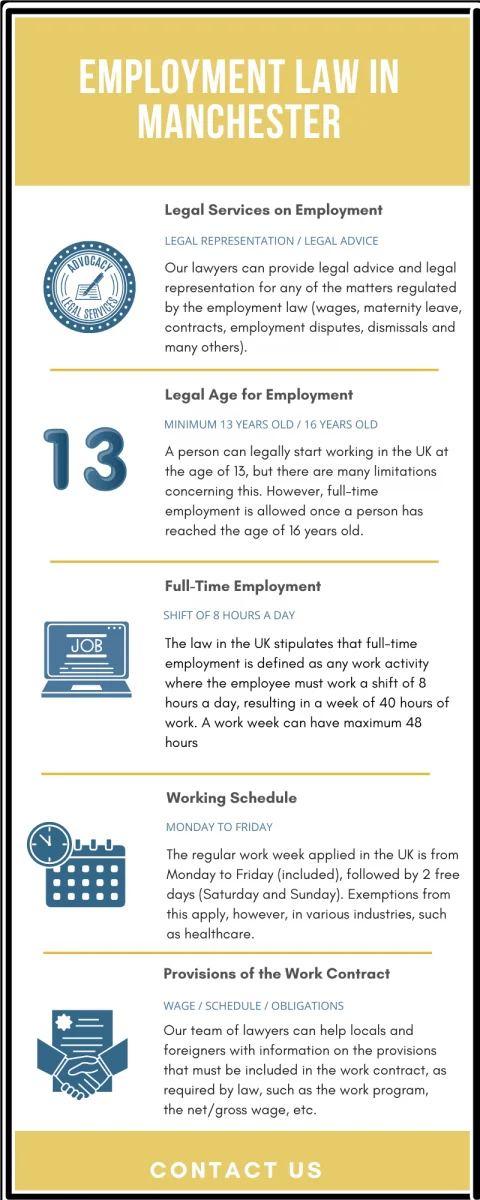
In the infographic below, you can find out some of the basics on the employment law in Manchester:
What is the minimum age of employment in 2026?
In the UK, a person can become an employee from the age of 14. However, they can only be hired as part-time workers in activities connected to theatre, television, modelling. Full-time employment for minorsis allowed only when they reach the age of 16.
What is the law concerning wages?
Foreign persons who want to work here should know that the legislation about the wage level in this country is regulated by the National Minimum Wage Act 1998.
What is the law on discrimination in the workplace?
Matters related to discrimination on various grounds are established under the Equality Act 2010.
If you need more details on the legislation or on other matters that you are interested in, our employment solicitors in Manchester remain at your disposal.
